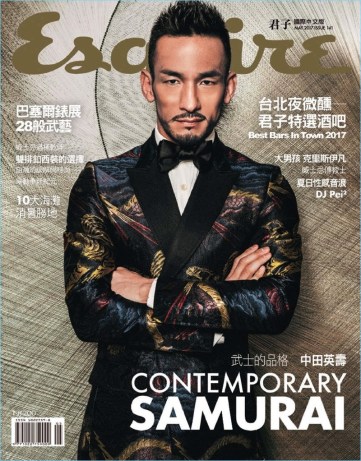
I genuinely think the western hemisphere is blissfully unaware of how big of a deal Hidetoshi Nakata was and still is. He was the first Asian player to become a legitimate footballing superstar due to his exploits on and off the pitch, being an incredibly marketable individual. Certainly the first time I became aware of the player was when he starred alongside other stars in a global Nike advertising campaign in the early 2000s, being one of the prominent figures in a Nike cage football tournament dubbed “Scorpion KO”.
Nakata started his career at what turned out to be his only Japanese club Bellmare Hiratsuka. He wouldn’t make his professional debut until 1995, but people first took notice of him at the 1993 Under-17 World Championships. Nakata was the heartbeat of that team. Playing in his trademark advanced playmaker roll, he drove his team forward and beautifully blended industry with mesmerising technical ability in a display of what was to come. Japan reached the Quarter-Finals which was a tremendous achievement for what was at the time a much more provincial nation on the football landscape.
After breaking into his senior club side at the age of 18, Nakata quickly became one of the best players in Asia, going on to win the 1997 Asian Confederation Player of the Year Award at the age of 20 and repeating the feat the following year.
He would be pivotal in Japan qualifying for the 1998 World Cup; averaging nearly a goal every other game and setting up all three goals as Japan defeated Iran in the final play-off. Despite this, Japan looked out of their depth at the actual tournement. While they were in a group with Quarter-Finalists Argentina and Semi-Finalists Croatia, they would have been disappointed not to get anything from the game against fellow debutants Jamaica. It was obvious though that Nakata was a standout of the side (both ability wise and visually thanks to his bleached hair).
There was a serious clamour for the player following the tournament as many teams would have realised that not only would they receive a brilliant player but understood that there was a huge merchandise opportunity in a rapidly growing market.
He finally decided on Perugia in Serie A and although they were a relatively small team in the division, the league was the strongest in the world at the time so he could really test himself there. A fee of €4 million was agreed, this seemed extortionate at the time for a 21 year old who had played in a league that was deemed irrelevant but Perugia made so much from Nakata 7 shirts that it ended up being peanuts. Nakata also repaid them massively on the pitch, producing what I would say was the most fruitful spell of his career. He scored 10 goals in Serie A from midfield in his first season and impressed pundits with his skill and willing to work for his team.
Another 6 months was spent at Perugia before Nakata finally got his break at a big club. In January 2000, Roma were flying at the top of Serie A and saw Nakata as the perfect player to help bolster the squad and help create more competition. Again, the fee seemed ridiculous, this time for €20 million, Perugia must have been chuffed! All of the money was repaid within one substitute appearance though. With Roma trailing 2-0 to second place Juventus, Nakata came on for Francesco Totti. He instantly swung the momentum of the game and scored a 30 yard screamer past Edwin Van Der Sar. He completed the performance by striking another belter; this time the shot could only be parried right into the path of Vincenzo Montella who duly obliged to level the scores. This meant Roma maintained a six point lead in the title race, they would not relinquish it.
Nakata was again shifted on in January of the following season, this time to Parma who had cash on the hip after selling many of their top players. A fee over €20 million was again shelled out but as discussed before, the players’ marketability in Asia was such that half of Japan was probably wearing Parma shirts overnight.
During his spell at Parma (which proved to be indifferent), the 2002 World Cup would take place. This was to be hosted by Japan and South Korea and only one player could be selected as the face of the tournament. This time, Japan made it through the group stages with Nakata again on sparkling form on the biggest stage, it almost seemed irrelevant that they were knocked out by beaten Semi-Finalists Turkey.
Nakata would go on to help Parma win the 2002 Coppa Italia, but if truth be told his club career fizzled out following this. He would subsequently move on to Bologna before being given another big opportunity at Fiorentina. Again, Nakata appeared not to be the player he once was though and in 2005 was loaned out to Bolton.
During this season, Nakata announced that he would retire after the 2006 World Cup in Germany meaning he would retire before the age of 30. The 2006 World Cup was his swansong, despite Japan not getting out of the group stages, Nakata was again the standout player.
He was well aware that a new career awaited him being the face of several global fashion labels and creating many of his own successful businesses. It almost seemed irrelevant that he had retired early; he had already left an incredible legacy due to the exposure that he gave to his home land. It does make me laugh that such an iconic player finished his club career at Bolton though.

 False 9