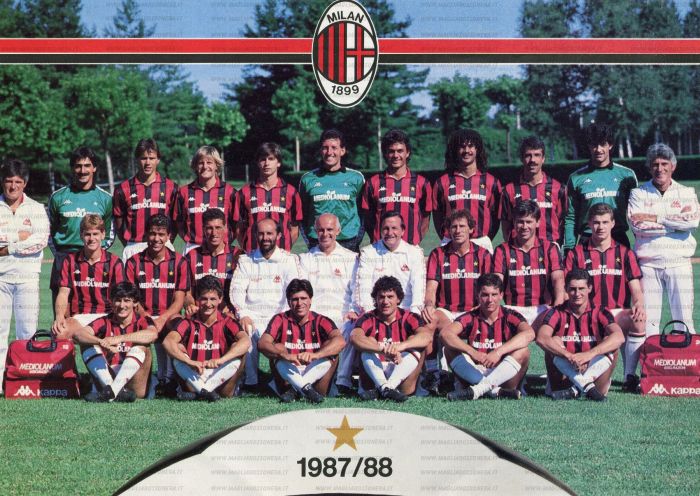
Maybe football is a lot simpler than we all think it is, a former shoe salesman with no professional playing experienced in his first top flight job managed to create one of the greatest club sides of all time, so much for reputation and having all of the coaching badges under the sun.
I do stretch the truth slightly, despite having no professional football experience, Arrigo Sacchi did have an extensive and reasonably successful career as an amateur, I wasn’t lying though about him being a shoe salesman, that did genuinely happen.
Sacchi grew up inspired by the great Budapest Honved side and subsequent Hungarian national side starring Sandor Kocsis and the best player of his generation, a chubby little forward called Ferenc Puskas. These sides thrived on mesmerising attacking play, movement off the ball and blistering counters (they also inspired Rinus Michels and in my opinion the other great club side of all time, early 70’s Ajax).
The attacking mentality that he loved was not shared by the vast majority of his Italian counterparts. Italian domestic football was then and partially still is today, a safety first nation. Great Italian teams prior to Sacchi appearing on the scene were built on great defences and conceding less than their opponent. This meant that Sacchi immediately stood out, even when he started out coaching in the lower leagues. I like to think he had an outsider’s point of view of Italian football in this respect because he’d never been involved in top level football.
After Sacchi hung up his boots to end a rather nondescript playing career, he gained a role as a youth coach at his local club Baracca Lugo. Despite their lowly ability, Sacchi’s revolutionary tactics were taken on board and he progressed through the club to become Manager at the age of only 26.
He faced difficulty to get a better job because at the time, Italians viewed anyone without top level playing experience as not being knowledgeable, something that Sacchi subsequently changed as shown recently by Maurizio Sarri gaining top level jobs, an accountant by trade.
He decided to take a job briefly with Rimini, before reverting back to youth football with Fiorentina. It was here were he refined what he believed to be his perfect style of play. This didn’t go unnoticed and an underachieving club in Serie C1/A, Parma, saw him as the man to revitalize them and push them back into the professional ranks (anything under Serie B is amateur football in Italy).
Sacchi encouraged his players to try and become more complete players so that they could become interchangeable and fluid, his own brand of total football basically. One of his biggest battles though must have been to force his players to drive out and press the opponents, traditionally, they would have probably all camped on their own goal line. Parma moved back into Serie B, walking to the title.
Following this, it wasn’t his exploits in Serie B that won him the Milan job. Parma drew Milan in the Coppa Italia twice in two seasons and defeated them on both occasions. This didn’t go unnoticed by a pre-politics and pre-bunga bunga Silvio Berlusconi, who took a rare leap of faith on an unproven manager based on two games of football. It’s a shame that young managers aren’t given the chance at all really these days and the same dinosaurs rotate around a few jobs. This is especially the case in the Premier League with so much money at stake.
Sacchi did inherit an already incredible team, especially across the backline, containing captain fantastic Franco Baresi and my footballing hero, Paolo Maldini. He also already had arguably the greatest number nine of all time Marco van Basten and all around beast Ruud Gullit, not a bad starting point in all fairness. He added Frank Rijkaard to the team and a supposedly past it Carlo Ancelotti who became integral to the team.
The biggest issue he was supposed to have was to get all of these already world class and egotistic players to buy into a philosophy they hadn’t come across before, delivered by a Manager with no experience at all, his methods could have seemed especially bizarre when the bulk of his initial training didn’t involve a ball and instead worked on shape and discipline. Thankfully, when you look at the list from the previous paragraph, all of his top players had outstanding footballing brains and realised Sacchi knew what he was talking about.
The benefits were immediately obvious and Sacchi won the Scudetto in his debut season (87/88), this would be his only league title however, mainly due to the defensive and frustrating setup of other teams and the fact that the Italian league at the time was probably the strongest domestic league in history. Inters German trio, Platini’s Juventus, Maradona’s Napoli, the league was littered with world class players.
It was his exploits in Europe though that would define the team though. The 1989 European cup was clinched with style and verve, Milan walloped Steaua Bucharest 4-0 to clinch the trophy, having battered the mighty Real Madrid 6-1 on aggregate in the Semi Final. No other team in Europe got close to them. The following year, Milan again overcame Real Madrid and then knocked out German giants Bayern Munich in the semi-final. The final this time was a much tighter affair, against a Sven-Goran Eriksson led Benfica who had set up not to concede, Rijkaard got the winner after a lovely bit of Van Basten movement, aahh total football. It’s a shame Sacchi didn’t ride off into the sunset at this point.
From what I’ve read in the past, after this, Berlusconi decided he didn’t like Sacchi all of a sudden due to not winning enough league titles and in 1991 used his burgeoning political power to shift him on to the national team and convince Sacchi that it was a promotion (it should also be noted though that Sacchi had fallen out with some senior players). As reference, Sacchi’s successor Fabio Capello won 4 out of the next five league titles and the 93/94 Champions League.
Sacchi got it all wrong at Euro 92 and Italy came unstuck against an average Norway side and by the time the 94 World Cup came round, he had his fair share of doubters and an obvious biased towards Milan players didn’t go down well with the rest of the country.
It didn’t start well, having lost to Ireland in their opening game. Somehow, his side coughed and spluttered their way to a world cup final, something that I think probably flattered their performance, and they were eventually stopped by a brilliant Brazil team.
He again failed at Euro 96 and that was the final straw. Personally, I don’t think Sacchi was suited to international football, how can someone with such a distinctive style of play implement his style in the space of a two week international break on a group of players that all play so differently at club level.
The rest of his career was largely unsuccessful, and he gained no more trophies. A brief and poor spell at Milan followed, finishing 11th, before moving to Atletico Madrid, where he fared even worse and finished 13th. He arrived back at Parma in 2001 but that didn’t work out either, Sacchi finally decided to call it a day after that.
Despite a disappointing career after Milan, you can’t deny Sacchi was a genius and you can’t really criticize someone who tries to play football in that way. I’d rather him over big Sam any day.

 False 9